
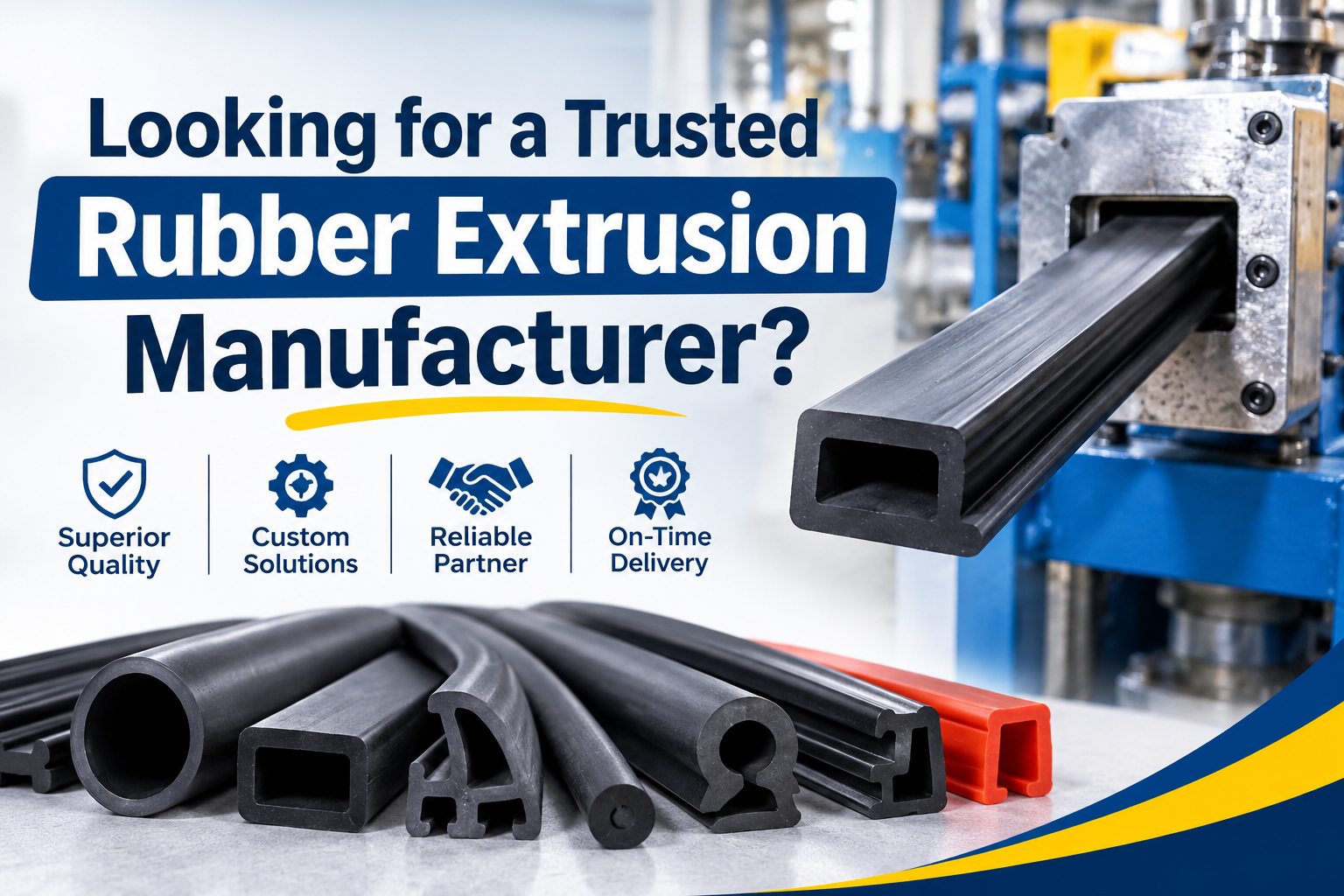
Production delay issues are usually due to some inconsistencies in performance of rubber components. Thus, specifications for "industrial assemblies" require materials with precise mechanical and dimensional properties. An acceptable rubber parts producer solves these tough production issues. This consistency in materials may determine service life, sealing efficiency, and reliability of the equipment. The technical challenges faced by businesses obtaining industrial rubber components include compatibility of compounds, dimensional tolerances, and scalability of production. Knowledge on the manufacturing side of production determines the consistency of recurrent orders for their components. Tooling capabilities may govern customization and production efficiencies.
Automotive, electronics, construction, and machinery industries require application-specific rubber components. Supplier evaluation therefore involves technical competence and manufacturing reliability. The blog covers rubber extrusion processes, differences between extrusion and molding, industrial rubber materials, and their applications across various manufacturing sectors. It also explains rubber extrusion manufacturers selection criteria, technical capabilities, quality standards, production scalability, and factors influencing long-term supplier reliability.
The Growing Role of Rubber Extrusion in Industrial Production
In machinery assemblies, prolonged rubber profiles are necessary to guarantee that components may work properly together. Rubber extrusion involves making the same shapes repeatedly using specific processes. Rubber profiles can be used in insulation, cushioning, and protection. They are critical for the operation of industrial machinery. Extruded products include rubber seals, gaskets, and tubing. Protective profiles are used for specific purposes. Rubber seals keep out fluids from leaks between parts of machines. Gaskets maintain the pressure seal. Tubing supports fluid transfer across industrial systems. Edge trims protect exposed surfaces against abrasion and damage. Consistent profile dimensions ensure proper fitting and sealing performance. Dimensional variations can compromise equipment functionality and assembly efficiency.
2. Key Differences Between Extrusion, Molding, and Silicone Processing
A. Rubber Extrusion
With rubber profile extrusion with the same cross-sectional profile are produced through a process of forcing uncured rubber through dies of a unique design. Rubber extrusion is particularly suitable for the production of long items with constant dimensions. Typical applications include seals, tubes, gaskets, etc.
B. Rubber Molding
Rubber molding creates the individual parts by using molds having cavities formed in specific shapes. There are different types of rubber molding, such as compression, injection, and transfer molding. The process allows for complicated geometries and unique designs depending on specific applications.
C. Silicone Molding
The process of molding silicone refers to the shaping of silicone materials to produce various industrial rubber products parts. Silicone is characterized by great elasticity, stability in terms of temperature, and the ability to insulate electric current. The technology of injection molding utilizes liquid silicone injected under controlled conditions into a cavity. The process of injection molding allows one to produce parts with complicated geometry and reach mass production.
D. Manufacturing Process Differences and Application Requirements
Extrusion is mainly used to produce continuous segments with an even shape. The real molding process describes the process of forming independent components with intricate shapes. The distinction between silicone molding and injection molding is determined by some properties of silicone and characteristics of the process. Tooling for extrusion is usually made of dies, while molding requires tooling with cavities and controlled vulcanization. In particular, in the case of liquid silicone injection molding, special injection and measuring systems are applied. The choice of the necessary manufacturing technology depends on the quantity of items to produce, the cost of tooling, and the geometry.
4. Material Performance Across Industrial Operating Conditions
Industrial rubber products used in the industrial sector come into contact with different types of temperatures, chemicals, and stresses. This affects the choice of compounds and the longevity of the components. EPDM is resistant to weathering, ozone, and exposure to the elements. Nitrile rubber is reliable for oil-contact applications. Silicone allows for flexibility in terms of wide temperature ranges for components.
Temperature has an effect on elasticity, thermal stability, and material aging. Chemical exposures may also cause swelling of the material or compound degradation. Stress may influence compression set, tear resistance, and dimensional stability. A custom silicone mold manufacturer supports specialized silicone component development. Such expertise accommodates complex geometries and demanding performance specifications.
Selecting a Manufacturer for Long-Term Industrial Requirements
Technical Expertise and Customization Capabilities
Manufacturing collaborations that last for a long time rely heavily on reliable manufacturing and engineering expertise. Having an engineering skill set makes complicated designs possible and creates customized designs for target applications. An expert silicone molding manufacturer company can meet certain silicone parts' design needs. Understanding of production processes also influences the precision of tooling as well as the compatibility of the materials used.
Quality Documentation and Production Reliability
Quality documentation demonstrates compliance with specified manufacturing standards. Inspection records support dimensional accuracy and production traceability. Consistent communication strengthens technical coordination throughout manufacturing projects. Reliable delivery schedules help maintain uninterrupted production operations. Manufacturing processes must align with actual product specifications. These capabilities support dependable long-term industrial supply relationships.
Conclusion
Component reliability in industries relies on the appropriate processes and material compatibility. Extrusion and molding deal with different shapes of products and manufacturing demands. The right compound is important for the reliability of the component in tough conditions. Dimensional tolerance ensures accurate assembly and operation of the machine. A professional rubber component manufacturer needs to have the expertise and capability to manufacture the components. Effective tooling may facilitate custom design and specifications of the component. Material knowledge further supports application-specific performance and product longevity. These capabilities influence operational efficiency and long-term manufacturing reliability. Strong supplier partnerships contribute to dependable industrial production outcomes.
Industrial Rubber Manufacturing Support for OEM Requirements
Rubber molded rubber products support industrial buyers with specialized rubber manufacturing requirements. Its capabilities address custom specifications, material selection, and production needs. Technical drawings support accurate manufacturing evaluations. Contact a molded rubber products manufacturer for industrial rubber manufacturing enquiries and project discussions.
Frequently Asked Questions About Industrial Rubber Manufacturing
1. How do extrusion manufacturers maintain profile consistency across production batches?
Extrusion manufacturers control die dimensions, compound viscosity, and curing conditions. Automotive and construction applications require consistent profile tolerances. These parameters influence sealing performance and component integration.
2. Which production requirements determine extrusion versus molding selection?
Extrusion is ideal for continuous profiles with uniform cross sections. Molding is better when complex shapes are required, along with different component designs. The cost of tooling, volume, and tolerances affect choice.
3. How does compound compatibility influence industrial rubber component performance?
EPDM is ideal for outdoor sealing applications calling for ozone resistance. Nitrile is employed in automotive and hydraulic applications exposed to oils. Silicone is used in applications in the electronics and medical industries where stable temperature is critical. Neoprene can be used in certain industrial and environmental conditions.
4. Which quality benchmarks matter for OEM rubber component procurement?
Dimensional inspection confirms the geometric properties of the part and its tolerances. Moreover, hardness and functional testing are performed in order to ensure material quality. In addition, ISO 9001 is evidence of quality management principles that are in place. Another standard, IATF 1694,9 maalso beso required for suppliers of automotive components.
5. How does manufacturing scalability influence long-term industrial supply agreements?
Production capacity determines recurring order fulfillment and volume flexibility. Tooling maintenance supports consistent output across manufacturing cycles. Batch traceability strengthens quality accountability and procurement reliability.